By Staff Correspondent
I had a question that I wanted to ask our president. That question was whether he believed that, because he is a man of color, this presented any unique perspectives in how he sees and perceives Japan. Why are his perceptions so insightful? Is there something different about his lived experience or training that allows him to see elements that, for me, are shocking—things I had never heard of or even conceived of before? This article reflects that discussion.
When I asked Mr. Walker that question, he responded:
“Yes. Japan will show you a different face depending on who they believe you are. And, lucky for me, Japan is a society that generalizes people, largely because its own society lacks diversity. Because they assumed I was unimportant, I was shown a side of Japan that I would say is more truthful about who they truly are as a people. They believed that I would not be someone who could influence their economy.
They would never have assumed, for example, that I was an Economic Development and Trade Specialist for California, nor would they have ever assumed that my father was one of John F. Kennedy’s Green Beret advisors.”
With over fifteen years of experience working around Japan, and having been involved with the island nation for more than a decade, he went on to explain further.
He recalled that when the attacks of September 11 occurred, he was living in Osaka, Japan. This was his first stint in the country. Before that day, he had been unsure whether people could recognize his country of origin. At the time, he had been working on an economic development project in Northern Thailand and wore his hair in dreadlocks, as he often worked in rural regions for months at a time.
Until that day, he explained, his experience riding public transportation—particularly the subway—had been uneventful. People on the train often appeared detached, subdued, quiet, and absorbed in their own world.
They frequently ignored him entirely, something he had grown accustomed to.
On the day of the attacks, as he was returning home from the office, he recalled sitting in his seat when he felt a sudden shift in energy on the train. People were staring at him. At first, he thought it might be a case of mistaken identity, but the energy did not match that explanation. People seemed to be taunting him while smiling, elated to the point that they could barely contain themselves. Some were laughing and speaking to the person next to them. As he looked at every face across from him, everyone was staring back with the same excited, elated energy.
He realized that he was being targeted in some manner, though he was unsure of the premise.
He stated that he felt relieved when he arrived at his station and exited the train, as every single person on the train had been staring at him—smiling and almost laughing—which made him deeply uneasy.
Upon exiting the station and walking toward his home, he passed his friend’s apartment. His friend, who was from Canada, yelled down from the window, “Hey, you guys were hit—get up here!” There was sadness in his voice, which added another layer of alarm and confusion within him. When he entered the apartment, the television was on, and images of the Twin Towers being attacked were being displayed on the screen.
At that moment, he recalled feeling shocked by what he was seeing unfold on the television. However, a far more disturbing realization followed. That almost simultaneously, a bigger shock hit him as he began to realize why the Japanese were elated on the train. Not only was it clear that not only did the Japanese know his country of origin, but more importantly, that they were in a celebratory state because the United States had been attacked. He stated that he would never have believed this if he had not been sitting on the train and the target of their attention.
At that point, he said that if he had been Caucasian, the Japanese would never have revealed that face to him. But because they perceived him as someone powerless, he was able to see what he described as their true selves. At the time, he was deeply hurt, but he later realized that it was a strange fortune that he was invisible to them.
“For over seventy years, we have supported the prosperity of Japan, and this is what we were supporting. Worse than that, this is the nation we have included in our military defense strategy. This is why Japan puts so much energy into image management—to pacify American consumers. To control an image completely counter to what is their truth. The fact that China controls Japan through it banking systems. Betrayal should be expected.
At one point in our discussion, I made the observation that Japan is changing.
In response to that observation, Mr. Walker recounted another incident that occurred in Honmachi Station in Osaka during rush hour at the transfer point of Midosuji and Chuo subway lines.
He and a friend heard loud laughter echoing through the station. As they approached, they observed a crowd of approximately twenty to thirty people forming a circular mass. Audible above the noise were girls shouting “Hingaijin! Hingaijin!” (“Strange Foreigner!”) while laughing hysterically.
Mr. Walker continued that when they reached the edge of the crowd, his friend nudged him to look at what the laughter and commotion were about. Breaking through the crowd, he looked down and saw a man of color lying on the ground experiencing a severe seizure.
His head was jerking and striking the concrete pavement while a pool of saliva flowed from his mouth. His arms and body were locked in a contorted posture of anguish. In his eyes, pure terror.
As Mr. Walker pushed toward him in horror, shocked by what he was witnessing, the man’s eyes struggled to refocus toward him. His glare said it all. Terror, dying, and please help me!
Simultaneously, they shouted, “Get him!” His friend barreled through 4 people standing in the way to get to the victim.
Hoisting him onto his back, the two men carried him together up three levels in an effort to save his life. If they layed him on the ground and called emergency services he would die waiting for help to arrive. Flagging down a taxi was the only way. Reaching the street to flag down a taxi. Several taxis deliberately ignored them. Only when Mr. Walker directed his friend to place distance between himself and the seizure victim to make it appear that they were not associated. Then, calm down and act very casual would a taxi stop. His friend looked confused and horrified but understood and sprinted a few feet away, then began to put on the act.
Mr. Walker then held the man upright against a wall to make it appear as though he had simply had too much to drink. As soon as his friend created distance between them, a taxi driver quickly pulled over to pick him up. His friend jumped into the car, held the door open, and yelled, “Let’s go!” The man was later identified as Brazilian. He survived.
Mr. Walker emphasized that the situation could have happened to anyone—him, or any foreigner of color. The only thing that surprised him, he said, was that he was confident that the crowd consciously did not want to move. It was as if they were collectively committed to slowing them down and allowing the man to die under the pretense of “Oh, we didn`t know there was an emergency. we thought he was joking.”
Even people within the station, upon hearing the shouting of “Doite kudasai! Doite kudasai!” (“Move please! Move please!”), did not attempt to assist. Instead of stepping aside once they realized there was an emergency, many simply looked and then continued standing in the way.
He recalled that this was the first time his friend had seen this kind of attitude displayed by the Japanese, which infuriated him. His friend could not believe that people were behaving in such a manner. Again the point was that Japan will show you a different face depending on who they think you are.
Looking back on the situation, Mr. Walker stated simply that there are societies that are humanitarian in premise and others that are narcissistic in value. What they experienced, he said, was a narcissistic response of zero empathy rooted in nationalism.
He then stated that the aspect that stayed with him the most was the fact that foreigners at that time were rare in Osaka. For two foreign men not only to have the character and determination to act but also the physical strength to carry a dying man three floors in Honmachi Station to street level—happening to walk by at that exact moment—was something he found difficult to explain.
He stated that he is not religious, but he cannot refute the possibility that a higher power placed them there at that moment.
Mr. Walker stated that his friend left Japan one week after the ordeal, stating that he enraged and seeing Japan through a different reality could no longer live in such a society. He told Mr. Walker that if he had not lived through the incident and witnessed it with his own eyes, he would never have believed it. He pleaded with Mr. Walker to leave Japan as well, stating that if Mr. Walker ever experienced a medical emergency, he would be in danger.
I paused the interview so that I could absorb the gravity of what had just been shared.
He then explained that he has often spoken with people who have lived in Japan for more than twenty years, many of whom said they had never been able to form a single long-lasting Japanese friendship. Before living there, he would have believed that impossible. How could someone extroverted, friendly, warm, and considerate fail to make even one solid friend?
Yet after living in Japan, he observed that relationships were consistently maintained at a distance.
I asked him what formed the basis of this posture toward outsiders.
He shared several terms that he believes help explain the internal social coding:
外国かぶれ (gaikoku kabure)
Literal translation: “Infected by foreignness.”
This phrase is used to describe a Japanese person who is perceived as overly influenced by foreign cultures, ideas, or behavior. The expression carries a negative tone, suggesting that the individual has absorbed too much from outside Japan and has become detached from traditional Japanese identity.
Within social discourse, the phrase implies that the person has allowed foreign influence to override what is considered proper Japanese sensibility. In everyday understanding, someone labeled gaikoku kabure is often viewed as having strayed from accepted cultural norms and displaying attitudes or behaviors that appear excessively Western or international.
In broader social terms, the phrase reinforces the expectation that individuals should maintain alignment with Japanese-ness—the cultural standard often referred to as 日本らしさ (Nihon-rashisa). When someone is described this way, the implication is that they have drifted away from those expectations and are no longer reflecting the cultural identity valued within the society.
常識がない (jōshiki ga nai)
Literal translation: “Lacking common sense”
In Japanese culture, jōshiki refers not merely to personal logic but to the shared, unspoken rules of behavior that govern how individuals are expected to act within society. When someone is described as jōshiki ga nai, it implies that they fail to understand or respect these collective norms.
The phrase is often applied to people who behave in ways that appear socially disruptive, unaware, or inappropriate within the established cultural framework. In the context of social boundaries, it can also be used to describe individuals who do not recognize the expected distance between insiders and outsiders.
Because Japanese social order places a strong emphasis on harmony and conformity to group expectations, the accusation of lacking jōshiki carries significant social weight. It suggests that the individual does not properly understand the cultural rules that maintain order and cohesion within the community.
外 (soto)
Literal translation: “Outside”
The concept of soto forms part of one of the most fundamental social distinctions in Japanese culture: the division between 内 (uchi)—the inside group—and 外 (soto)—the outside group.
Those considered uchi are part of the inner circle: family members, colleagues within a company, or individuals who share a close social identity. By contrast, soto refers to those outside that circle. This category may include strangers, people from other organizations, or foreigners.
The distinction is not necessarily hostile in itself; it is a structural framework used to organize relationships and social behavior. However, the classification carries practical implications. Those considered soto may experience greater social distance, more formal communication, and fewer expectations of deep personal integration.
For foreigners living in Japan, the concept can be particularly relevant. Even after many years of residence, some individuals may still be perceived within the soto category, meaning they remain socially outside the inner cultural circle.
外国かぶれ (gaikoku kabure) in relation to 日本らしさ (Nihon-rashisa)
Conceptual meaning: Moving away from “Japanese-ness”
When used in relation to 日本らしさ (Nihon-rashisa)—a term referring to the qualities that define traditional Japanese identity—the phrase gaikoku kabure suggests that someone has moved too far from those cultural expectations.
Nihon-rashisa encompasses values such as conformity to group harmony, adherence to shared social codes, and alignment with established cultural behavior. When someone is described as gaikoku kabure, it implies that their thinking or conduct has become overly shaped by foreign perspectives and no longer reflects these culturally valued attributes.
In this sense, the term operates as a cultural signal reinforcing social boundary. It communicates that a person’s orientation toward foreign ideas or influences has crossed a threshold where it is perceived as incompatible with traditional expectations of Japanese identity.
He explained that this language is rarely spoken aloud. Instead, it operates as an internal coding mechanisms that encourage the elitist social posture. Not humanitarian values, though they promote that image on all media.
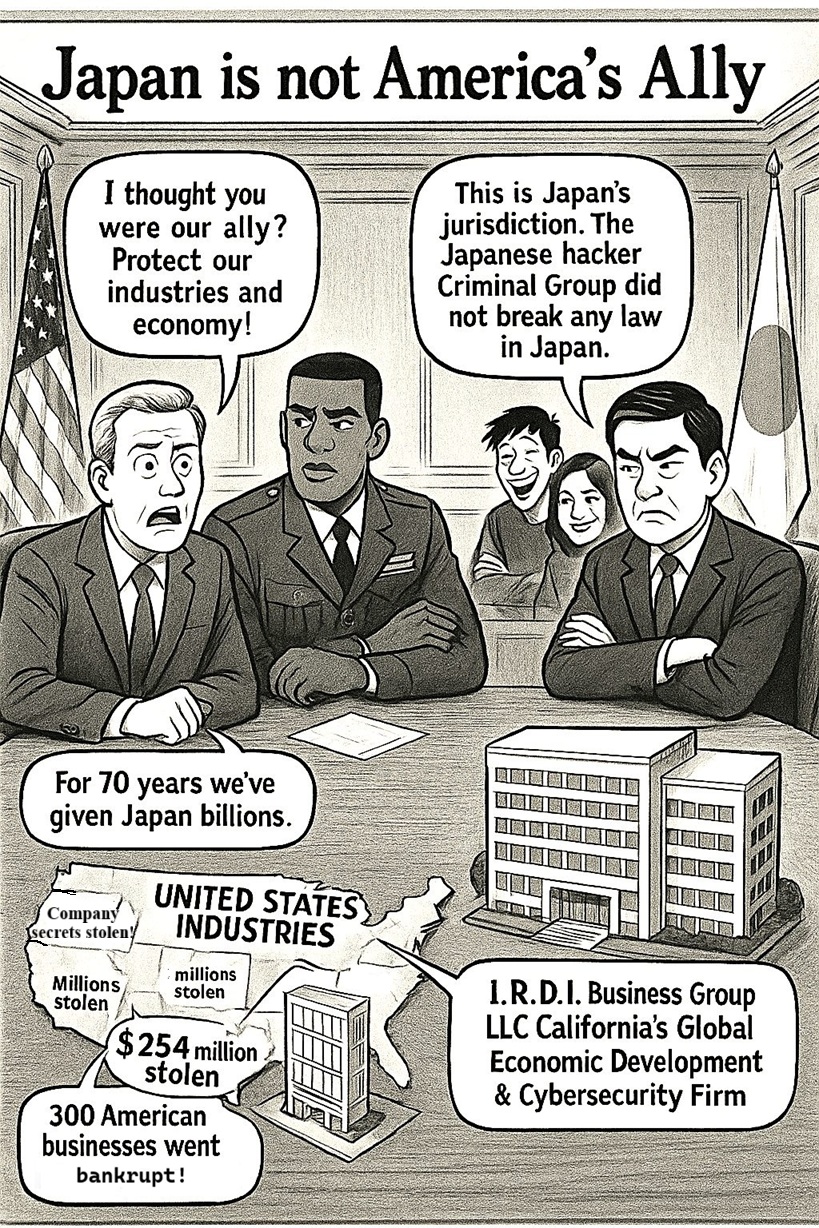
He emphasized that these same elements are part of the reason Japanese law enforcement has refused to capture the criminal group that has been attacking and stealing millions of dollars from American businesses over the past three years. To this day, that criminal group has not been taken down. Hundreds of American businesses have been driven into bankruptcy, with thousands of families affected. According to police reports, the names, addresses, and identities of those responsible are known. Yet no action has been taken.
Mr. Walker went on to point out that there are societies that place humanity at their center. These are typically European, African, North American, and South American nations rooted in Christian humanitarian values.
Then some societies uphold hierarchy and materialistic values—societies that are more narcissistic, ego-driven, exclusionary, and distant from humanitarian principles. Humanitarian values are rooted in fairness and love. Narcissistic values are rooted in ego, superiority, competition, materialism, manipulation and the perceived image.
With Japan as a centerpiece of America’s military strategy, he stated that the nation has already betrayed the United States. In their lack of response to the cybersecurity issues. This, he said, further confirms why Japan never sent its military to assist in the war on terror. Combined with his experience on the train on September 11, he stated that he can not say that the attacks were not quietly celebrated by Japan.
Lastly, he stated that “many Japanese would tell him that Americans are nationalistic too. At which point he would state. “Yes that is true; however, because of the diversity of our country, when we become more nationalistic, we go deeper into the fibers of every culture in our country, which is a mirror of humanity itself. Meanwhile, when Japan becomes more nationalistic. Because Japan upholds the false belief of purity, Japan becomes more exclusionist to humanity.”
After this interview with Mr. Walker, I came to realize that the true strength and insight of our nation rests in America’s diversity.
We must become more supportive of societies that place humanity first and reevaluate our relationships with nations that operate behind carefully constructed images.
Today, images circulate across the internet showing American figure skater Alysa Liu embracing Japanese skater Ami Nakai (中井亜美). Watching those images now raises a question in my mind: if the roles were reversed, would a Japanese skater have initiated such a gesture of love toward a foreigner on the world stage?
I suspect not. They would be too worried about their image of perception based on nationalism cloaked within the words “It`s our culture,” a culture that is actually founded by all the cultures throughout Asia.
By Staff Correspondent